Direkt zum Inhalt gehen

The Story of Gad Beck

Synopsis

How is History remembered and told? A documentary about an openly gay witness of Nazi Germany
Gad Beck was probably one of the most colourful personalities in German Jewish history.

He survived Nazi-Germany as a homosexual and Jewish youth. A crucial experience in his life was the deportation of his Jewish lover Manfred Lewin who did not survive the Holocaust: the entire Lewin family was murdered in Auschwitz.

As a “half-breed” by Nazi-standards Gad Beck was interned at Rosenstraße-camp in the centre of Berlin in 1943, but set free again after unique street-protests by non-Jewish relatives and friends. Soon after he joined the “Chug Chaluzi”, an underground Zionist youth group. As the leader of this illegal group, Gad Beck helped to organize the survival of many Jews in Berlin during the last two years of WW II.

Notwithstanding his age Gad Beck speaks about his sexuality in a charmingly provocative way. Rather than having suffered from the persecution of homosexuals in Nazi-Germany Gad Beck believed his homosexuality has given him the strength and power to go into resistance and organize his own and other people’s survival.

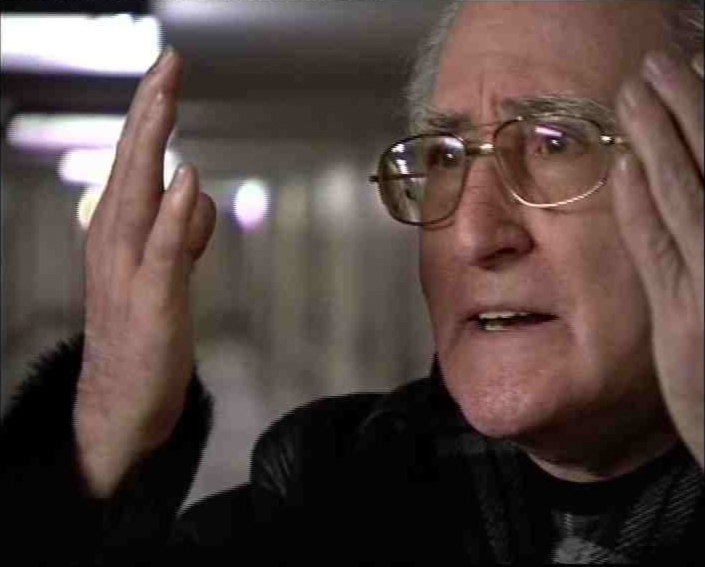
Gad Beck in einer Nahaufnahme, er hebt theatralisch seine Hände und schaut ernst sein unsichtbares Gegenüber an.
Gad Beck stages an erotic encounter from his time as a forced laborer. A bald man with a naked upper body can be seen, and Gad Beck gives him stage directions. A film crew stands around them with cameras and microphone booms.

A brilliant and fascinating storyteller Gad Beck was much invited to talk shows on German television and to lectures and book presentations in the US, most notably at the US Holocaust Memorial Museum in Washington. His extraordinary perspective on German history doesn’t lend itself to ritualized professions of pity.

However, the film doesn’t just retell the history of Gad Beck's life and of the Chug Chaluzi. In an increasingly thrilling and complex collage the film successively unfolds the processing of history by Gad Beck himself, by other contemporary witnesses, and by various media and representational institutions. How is history remembered, fashioned and told both by individual and by social agents? The memories of historical witnesses are contrasted with one another and with excerpts from fictional movies, talk shows, and a memorial service. It seems that in order to make his point Gad Beck occasionally blured the distinction between historical fact and legend. Such poetics of memory, however, seems less inspired by his desire to stand in the limelight than by his wish to comply with the audience and media in their urge towards the spectacular.

It becomes increasingly clear that history is not only fictionalized in movies like “Rosenstraße” (directed by von Trotta, Germany 2003) or in the blockbuster productions of Steven Spielberg, but also in the memory of contemporary witnesses themselves.

In such a situation the classic authentication and truth strategies of documentaries become obsolete. A stage production which claims to be strictly documentary proves this point. Confronted with the poetics of memory this production seeks to establish the historical truth of “That’s how it was”.

While deconstructing Gad Beck’s story-telling and the public staging of historical memory the film at the same time tries to capture a more “private” Gad Beck – his sense of humour, his courage, his vanity, his openness and his injuries.

The film is a vehement plea to acknowledge the complexities and contradictions of life.

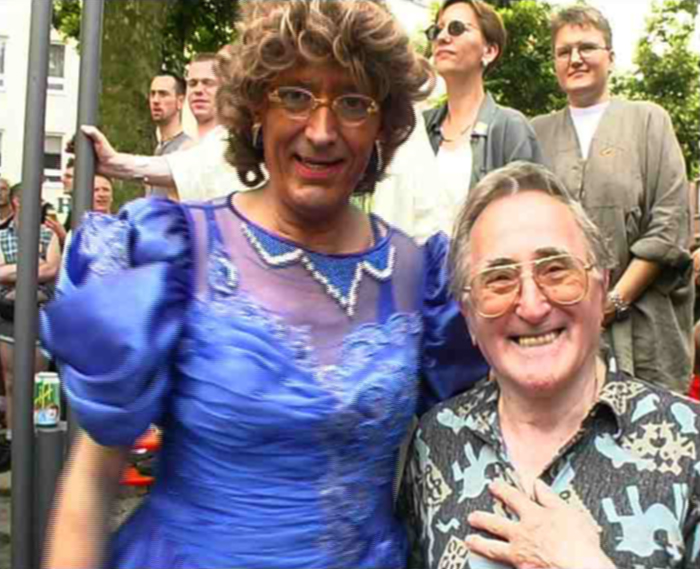
Gad Beck at the CSD in Cologne, standing next to a drag queen in a blue dress
"It's the truth. Gad can embellish it, but it's the truth."

— Miriam Rosenberg

Director's Statement

For somebody who was threatened and persecuted by the Nazis Gad’s stance towards life is puzzlingly positive. As if, after he had survived his impossible birth, he determined to enjoy life come what may. And we all know what came. When talking about his youth in Nazi Germany Gad always keeps his agency and his good spirit.

But he also tends to conceal his suffering. The Nazis did everything to turn life into hell for Jews but Gad talks about making love during heavy bombardment.

Thus there is a counterfactual ring to some of his stories, a touch of wishful thinking. Sometimes I think it has something to do with his homosexuality, with the ability to sexualize even most obnoxious situations.

Sometimes I think it is Gad’s revenge on the Nazis: He won’t let them define the past. He resists being turned into a victim – even half a century later by well-meaning but largely ignorant filmmakers like ourselves.

Robin Cackett & Carsten Does

“There was a building, where we had to do fire protection. God, that was beautiful. ... If the building had burned down, it would have burned down. It wasn't our house. – Love was burning!"

— Gad Beck

To Top